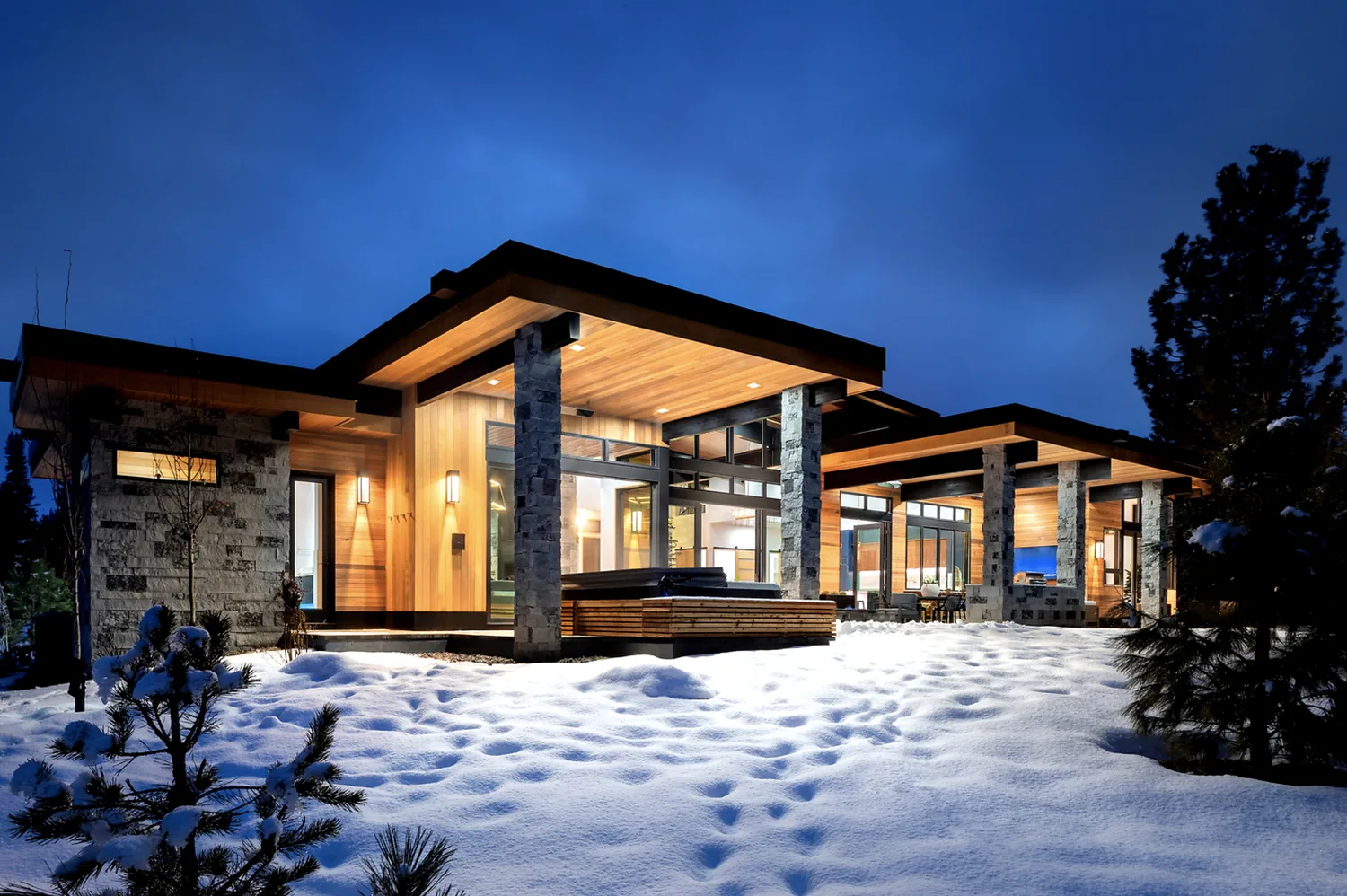
Thin veneer and full veneer are the same natural stone from the same quarry. The difference is how deep each piece is cut, and that one number decides what the wall needs behind it, what the stone weighs on the truck and how a mason sets it. Once it’s on the wall, the face reads the same.
| Thin veneer | Full veneer | |
|---|---|---|
| Depth | Sawn to about 1¼ in deep | Full depth, about 3 to 5 in |
| Weight | About 10 to 15 lb per sq ft | About 35 to 60 lb per sq ft |
| What holds it | Set in mortar (adhered) to a prepared wall | Stacked on a footing or ledge and tied back to the wall |
| Foundation | None needed | A footing or structural ledge |
| Corners | L-shaped corner pieces cut from the same stone | Full pieces turn the corner |
| Often chosen for | Remodels, upper floors, interiors, over existing walls | New builds designed for masonry, freestanding walls, deep returns |
What holds it up
Thin veneer is adhered: the mason sets each piece in mortar on a sound backing, such as concrete block, poured concrete, cement board, or a scratch coat over metal lath on a framed wall. The stone hangs on the bond, so the wall needs no footing or ledge, and it can go on an upper floor, a fireplace surround or an existing wall.
Full veneer is anchored masonry. The weight sits on a footing or a structural ledge, and metal ties hold the stone back to the wall behind it. It needs to be designed in from the start: the foundation, the ledge and the air space behind the stone.
Do they look different?
On a flat wall, no: the face is the same stone, with the same color, texture and pattern. The difference shows where the wall turns. Full veneer shows its full depth at window and door returns and at the end of a garden wall. Thin veneer turns outside corners with L-shaped corner pieces cut from the same stone, so the corner reads as solid; at deep returns, ask us how the pieces will turn.
What drives the cost
- The wall behind it. Thin veneer needs no footing or ledge, which is often the biggest saving.
- Labour. Lighter pieces set faster, and a mason can carry more of them up a scaffold.
- Freight. A truck carries the same weight either way, so it carries several times more square feet of thin veneer.
- Corners. Thin veneer corners are their own pieces, priced by the linear foot, so count your outside corners.
Pallets and freight
A pallet of thin veneer flats carries about 150 square feet at 1,800 to 2,200 lb. Corners ship on their own pallets, about 100 linear feet at 500 to 1,000 lb. A full truckload is about 22 to 24 tons. Full veneer weighs three to four times as much per square foot, so plan the truck, the forklift and where the pallets will sit on site.
How to choose
- Choose thin veneer for a remodel, a wall with no footing or ledge, upper floors, interiors and fireplaces, or anywhere weight matters.
- Choose full veneer for a new building designed for masonry, freestanding garden and site walls, or deep returns where you want the stone’s depth to show.
- Mixing is common. Many projects use full-depth stone for site walls and caps and thin veneer on the house, in the same stone.
What the code allows for adhered stone
The building code limits adhered veneer through the masonry standard it references, TMS 402. Under the edition in the 2018 and 2021 codes, and in California’s 2025 code, an adhered unit weighs no more than 15 lb per square foot and is no more than 2⅝ in thick; the 2022 edition raises the weight to 30 lb. California also asks for anchored veneer above 20 ft when units are thicker than ⅝ in. Natural thin veneer, at about 1¼ in and within 15 lb, fits the adhered limits; full veneer is anchored, not adhered. Check which edition your building department uses: our specifying guide has the detail.
Ordering
Tell us the square feet of flat wall and the linear feet of outside corners, and which veneer style you want. Each stone’s page shows whether it comes in thin veneer, full veneer or both. You can sketch the walls in our Stone Calculator, or send plans and we’ll pull the quantities for you.
Updated November 2026. Part of Insights.