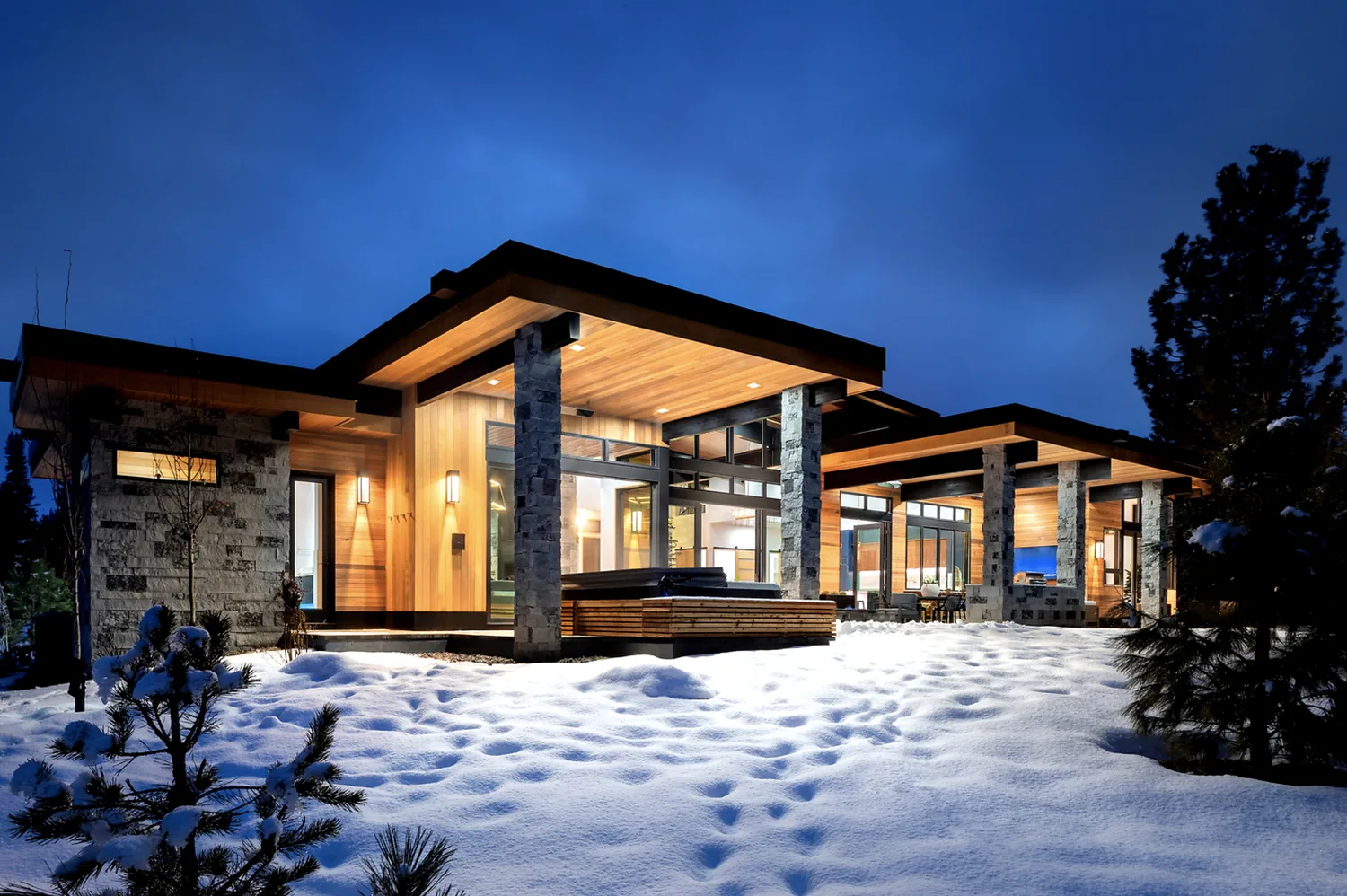
Around Lake Tahoe, Truckee and the Sierra foothills, many homes are built under California’s wildfire rules. Natural stone is mineral: it doesn’t burn. That makes it one of the simplest ways to meet the rules for exterior walls, and a natural fit for the ground around a house. Here is what the code asks, in plain English.
This is a guide, not code advice. Your building department and fire district have the final word, and section numbers change with each code cycle.
The code moved on 1 January 2026
The wildfire rules that used to be Chapter 7A of the California Building Code (and R337 of the Residential Code) now live in a code of their own: the 2025 California Wildland-Urban Interface Code, Title 24 Part 7. Its Chapter 5 carries the building rules. It applies to new buildings in any Fire Hazard Severity Zone in the State Responsibility Area, and in High or Very High zones where the local agency is responsible. Your building department will tell you if your lot is in.
Exterior walls
Section 504.5 lists the ways an exterior wall can comply: built of noncombustible materials, one-hour fire-rated, heavy timber, or a tested assembly, among others. A wall can also comply by its covering: section 504.5.2 accepts a noncombustible wall covering, an ignition-resistant one, or fire-retardant-treated wood.
The code defines noncombustible by a test, ASTM E136, rather than by listing materials. Natural stone is mineral and doesn’t burn, which is why it’s used as a noncombustible covering. Some building departments take that on its face; others ask for data. If yours asks, tell us the stone and we’ll send what the quarry has tested.
Thin and full veneer are the same stone, so both serve as the covering. The choice between them is about weight and structure, not fire: see Thin vs Full Veneer. The covering runs from the top of the foundation to the roof, and ends at solid blocking or an enclosed eave; your designer details that.
What stone doesn’t cover
- Vents have their own rule (504.10): listed ember-resistant vents. Stone around a vent doesn’t change it.
- Eaves and soffits (504.3), windows and roofing each have their own requirements.
- Flashing where a wall meets the ground, a deck or a roof: at least 6 inches of metal or noncombustible material.
Decks, porches and stairs
Section 504.7.3 lets the walking surface of a deck, porch, balcony or stair be a noncombustible material, among other options, which is where stone pavers and treads come in. The structure under a deck has rules of its own, so the deck’s designer has the full picture. A patio laid on the ground isn’t a deck under this section.
The first five feet
California is writing rules for the ground within five feet of a home, often called Zone 0. The Board of Forestry’s draft keeps combustible mulch, firewood and new combustible fences out of that strip, and uses the same ASTM E136 meaning of noncombustible. As of late November 2026 the rules are still under state review and not yet in effect; existing homes would get years to comply. Stone paving and gravel are the obvious fit for that strip either way.
Truckee and Nevada
- The Truckee Fire Protection District enforces its own defensible-space ordinances, including an inspection when a home sells.
- Washoe County, Nevada, builds to the 2024 International Wildland-Urban Interface Code (since 1 July 2025).
- Incline Village and Crystal Bay adopted the 2024 Lake Tahoe Nevada WUI Code, in effect from 1 January 2026.
Where we help
Pick the stone and the format, thin veneer, full veneer, pavers or treads, and we’ll send samples, the stone’s tested data where the quarry has it, and a project budget from your plans.
Updated November 2026. Part of Insights.